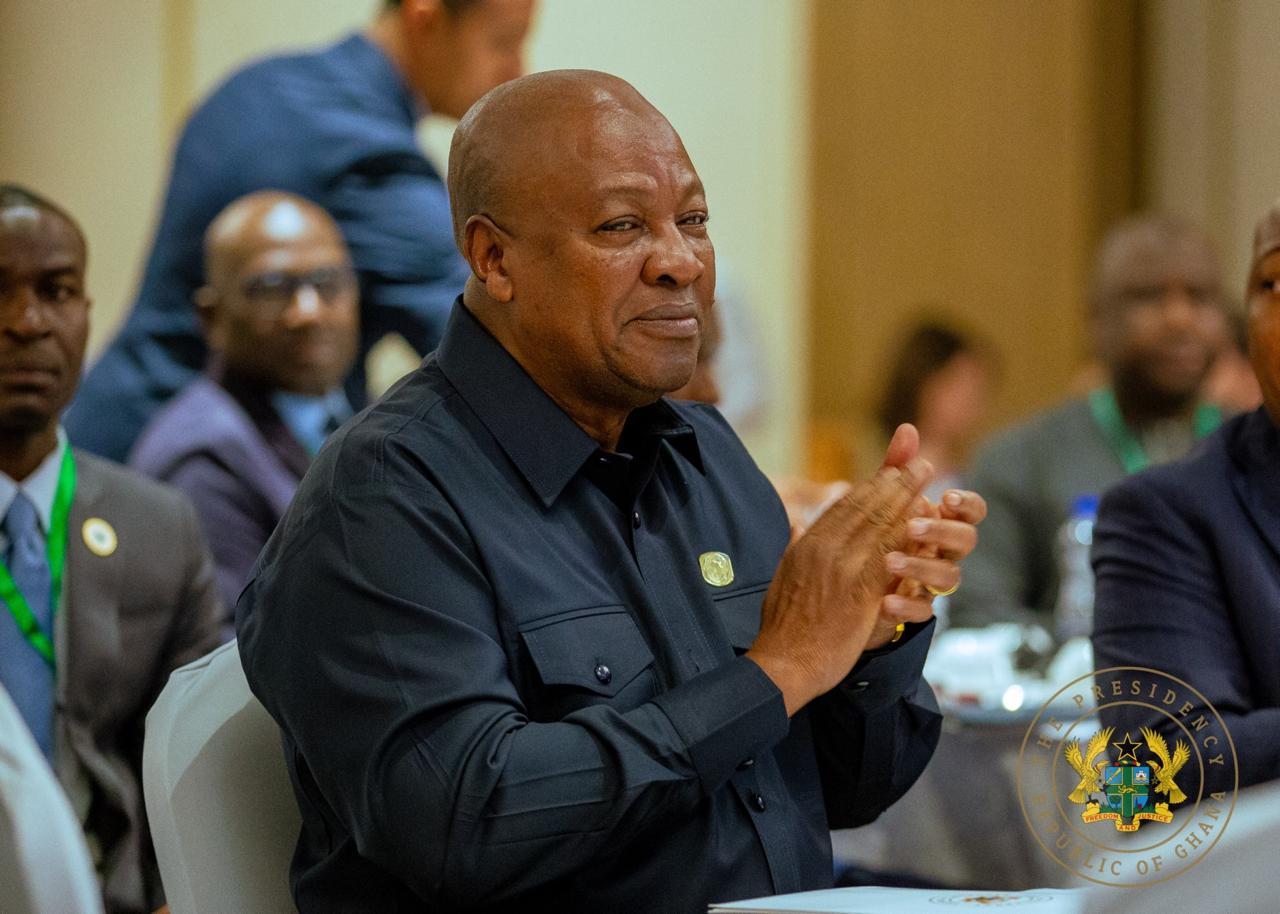
President John Dramani Mahama has reaffirmed his government’s dedication to transforming the economy from a primary exporter of raw materials to a competitive participant across the global extractive value chain.
During his speech at the Local Content Summit 2026, hosted by the Minerals Commission in Takoradi under the theme ‘Strengthening local content and indigenisation, building a resilient mining sector in Ghana’, he presented an ambitious plan aimed at enhancing local content, fast-tracking industrialisation, and positioning Ghana as a technology-driven mining hub.
He noted that while Ghana continues to be Africa’s foremost gold producer and ranks among the top six worldwide, much of the high-value activity in advanced engineering, processing, equipment manufacturing, technical services, and refining still occurs outside the nation.
“We’ve been prolific producers, but we have not yet become full participants in the extractive value chain,” he remarked.
He urged stakeholders to contemplate the long-term legacy of Ghana’s mineral wealth, questioning whether, a century from now, it will be remembered merely for export figures and royalty income or as the foundation for world-class industries, thriving Ghanaian enterprises, and resilient mining communities.
Drawing insights from Botswana, Chile, and Indonesia, President Mahama stated that well-designed, enforceable, and forward-thinking local content policies do not hinder investment; rather, they foster sustainable competitiveness.
The key, he emphasised, is finding a balance, policies should be ambitious yet realistic, and robust yet performance-oriented.
Firstly, he emphasised that local content must progress from mere transactional procurement to transformational partnerships.
The government is currently reviewing mining legislation and regulatory frameworks to ensure that Ghanaian businesses move up the value chain, transitioning from suppliers of consumables to manufacturers of essential components and innovators.
He asserted that equity participation, technology transfer, and knowledge-sharing must become common practices.
Secondly, he deemed it unacceptable for Ghana to continue exporting raw ores while importing finished products, setting a five-year target to eliminate raw ore exports.
He vowed support for refineries, bullion infrastructure, mineral-based innovations, and industrial clusters, while promoting downstream processing of bauxite, manganese, and lithium in alignment with the global green energy transition.
Another crucial strategy he identified focuses on human capital development. Institutions such as the University of Mines and Technology and technical universities will be enhanced, alongside expanded apprenticeship programmes in collaboration with the mining industry.
Skills in automation, robotics, drone technology, data analytics, environmental sustainability, and renewable energy integration will be prioritised.
Additionally, the President underscored that the future of mining is digital and driven by technology.
Ghana, he asserted, must position itself as a hub for AI-assisted exploration, IoT-enabled asset management, blockchain-based supply chain transparency, and locally driven research and development.
The government will consider establishing a national mining innovation and research hub to institutionalise this transformation.